
Project Notes / Project Summary
Cycle count statistics that turn inventory accuracy into an operating story
How cycle count work moved from transactional count activity into history, variance reporting, and performance scorecards.
The business problem
Cycle counting can look disciplined on the surface while still leaving the business without a clear answer to a simple question: is inventory accuracy getting better? Teams may generate counts, complete them, and post adjustments, but the result often disappears into transaction history that is difficult to summarize.
The practical problem is not count execution. It is visibility after the count. Operations needs to know what was selected, what was counted, what was correct, what remains open, and whether the process is improving. Finance needs to understand the dollar impact of adjustments without reconstructing the answer from exports.
Why it matters
Inventory accuracy affects planning, purchasing, production, service, and month-end review. When cycle count results are not summarized consistently, the business loses the ability to compare one period to another or explain why a large adjustment happened.
The count also needs context. If the count population changes between generation and completion, or if warehouse-specific rules are not reflected in the count setup, the final variance can be hard to defend. The system has to preserve enough history for the team to understand the starting point, not only the posted ending point.
The solution pattern
The implementation followed the cycle count process in the order the work happens. First, warehouse-level ABC logic was added so count generation could respect the way inventory is managed locally. Then the generation event was archived, creating a record of the count population at the time it was selected.
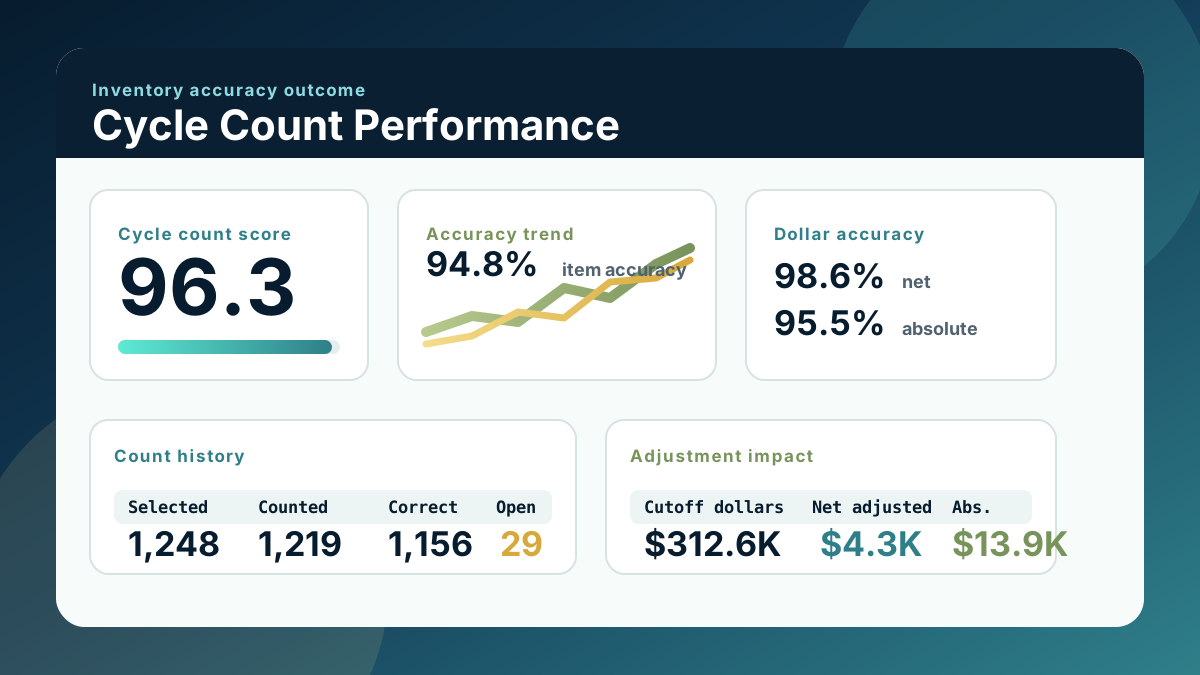
From there, the variance reporting was extended to show the statistics the business needed: number of items selected, number of items counted, number of items correct, item accuracy percent, total cutoff dollars, net dollars adjusted, absolute dollars adjusted, net dollar percentage accuracy, absolute dollar percentage accuracy, and cycle count score.
- Use warehouse-level ABC rules to determine count eligibility.
- Capture cycle count generation history before completion changes the picture.
- Preserve selected, counted, correct, and open count status.
- Tie adjustment reporting to posted activity.
- Summarize item accuracy, dollar accuracy, and cycle count score over time.
The implementation pattern
A cycle count history view gave users a place to inspect generated counts after the original run. A performance view let the team choose a start date, interval, and day, week, or month grouping so accuracy could be reviewed as a trend instead of a one-time report.
The variance report became the bridge between operations and finance. It did not just show that items changed. It separated item accuracy from dollar impact, and it showed both net and absolute dollar accuracy so the team could see whether offsetting adjustments were hiding real movement.
The operational value
The outcome is a shared language for inventory accuracy. Operations can see whether count discipline is improving. Finance can see the adjustment impact without manual cleanup. ERP owners can support the process because the logic is inside the system instead of scattered across one-off files.
The scorecard also creates a better management conversation. Instead of asking whether cycle counts were completed, leaders can ask whether item accuracy improved, whether adjustment dollars are trending down, and which warehouse or item class needs attention next.
Next step
Need cycle count results that are easier to explain?
Business Intuition can help turn count activity, history, and variance reporting into a repeatable inventory accuracy scorecard.